Medieval Dress: Sources and
Applications
True or False? ART AS WITNESS TO AN AGE
From Dress in
the Middle Ages, Pipponier and Maine
At first glance it might appear that clothed figures abound in medieval art: men and women are captured in stone around the door- ways of cathedrals, or hidden away between the parchment leaves of gold, purple and sky-blue miniature paintings.
It is in terms of quantity that the main variations between periods and regions manifest themselves. Some materials, in particular textiles and wood, are fragile; only a few exceptional examples have survived, such as the eleventh-century embroidery known as the Bayeux Tapestry, and some later embroideries and painted fabrics. Tastes also change: from the Middle Ages on, Romanesque buildings with their painted and carved decoration began to be demolished to make way for Gothic cathedrals. By the seventeenth and eighteenth centuries medieval art was itself in disfavor, and more than one cathedral was disfigured with neoclassical plasterwork, its stained glass being removed and replaced by colorless windows. Medieval abbeys, secular buildings, objects and hangings suffered even greater damage.
Notwithstanding current efforts to preserve the basic essentials, the twentieth century has taken its toll: wars, in particular the Second World War, have swept across almost the whole of what was the medieval western world, taking with them a great deal of the evidence that had hitherto survived.
Regional differences are responsible for imposing further limitations. on iconographic evidence. Artistic expression took different forms at different times across Europe and was not to be found in equal measure everywhere. Production depended on patronage and reflected the demand and the ideology of the patron. Civil authority, after the intense centralization of the Carolingian Empire, became 91somewhat diluted.
|
|
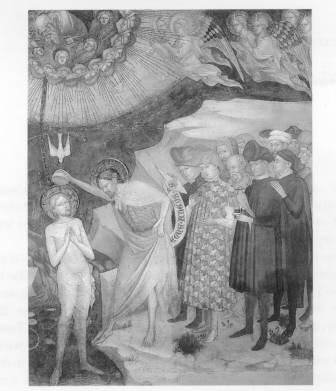
I Lorenzo and Jacopo Salimbeni: Baptism of Christ (detail). Oratorio San Giovanni Battista, Urbino, fresco, 1416. Loose overgarments, open under the arms, were worn by male members of the aristocracy in fifteenth-century Florence.
The Church continued to commission elaborate pieces of work to decorate buildings and to accompany acts of worship, but in the monastic world a brake was put on decoration by the influence of the Cistercians, who rejected all ornamentation in their bare-walled architecture. The growth of towns and the formation of kingdoms, with the concomitant economic development and concentration of wealth, stimulated the emergence of a less exclusively religious art, and one that varied from region to region. Although this development persisted to the end of the Middle Ages, modes of expression and artistic centers changed.
Even when art was created for the laity it remained devotional in inspiration throughout the whole of the Middle Ages. The principal- objective of any work of art, whether it was a huge architectural scheme or a small object for personal devotion, was to illustrate and propagate the precepts of Christianity. An artist depicting characters from the Bible or the lives of the best-loved saints would often copy earlier representations, without bringing the clothing up-to-date. Or he might take his inspiration from his own surroundings, dressing his figures according to the custom of the day. Scenes from the Bible, or representations of the seasons in which each month of the year is symbolized by an activity, gave the artist scope to. depict everyday reality. Religious subjects, however, were not treated in realistic fashion until the fourteenth century, when secular art began to develop separately. Copies of earlier models and stereotypes did not disappear altogether, largely because there were still workshops mass-producing them.
Pictorial representation cannot therefore be used as the only reliable source for the study of medieval costume. Each item has to be viewed strictly in the context of its production, and its documentary value be considered in the light of the author's intentions and the techniques employed. It is often difficult to date works with any certitude. For example, a funeral effigy on a stone slab may bear the date of its subject's death, yet it may have been executed decades later and may represent the deceased wearing clothes or armor that he never wore in his lifetime.
The dimensions of a piece of work also have some bearing on the information to be gathered from it, although once again this cannot be relied upon totally. The quality of workmanship and the care in handling details varied, even in the work of the most skilled artists. Sculpture has the advantage of representing three-dimensional figures, generally on quite a large scale. Clothes, with their draperies and their accessories, are often rendered very faithfully, even though the colors may have faded or been altered by weather or by restoration. The small size of ivories, enamels and medals, and even more so of the wax or lead seals attached to documents on parchment, necessitated the simplification of forms. The constraint inherent in media such as mosaic, stained glass or embroidery imposed a degree of stylization that did not favor detailed representation of styles of clothing. These techniques, however, provide important information about color, itself one of the key elements of costume. Painting is also irreplaceable in this respect, although the possibility of changes to the colors used by artists on wooden panels or on fabrics has to be borne in mind. Miniature paintings have in general been better protected from the ravages of time.
|
|

Still on the subject of color, we are faced with the problem of whether these reflect contemporary reality with any exactitude. In fact the range of colors used was often limited by technical constraints; in the oldest frescoes the tones are muted and there is no evidence of the use of blue or bright red. Miniatures, on the other hand, retain their sparkling colors, in particular those painted in the late Middle Ages; the brilliance of the richest of these is enhanced with gold. Furthermore, the artists' choice and combination of colors carry meanings that have to be decoded individually: some colors exalt the person wearing them, others demonstrate the wearer's lack of prestige or even vices.
To add to these difficulties, it must be remembered that pictorial representations do not give us the kind of panorama of medieval society in which the various social groups would be represented in pro- portion to their numbers. Like the Church, medieval iconography is predominantly masculine. Members of the female orders seldom appear at the side of the popes and bishops, priests and monks. Female figures are scarce among the laity as well, and are seldom depicted until late in the Middle Ages. Neither women nor children are to be found in the carved stone representations of the seasons of the twelfth and thirteenth centuries. In giving importance to the great and powerful, these reflect the hierarchical society in which they were made. A pope, bishop or abbot will take precedence over a simple priest or monk, unless the priest or monk has been canonised. Emperors, kings and powerful landowners and, at a later date, well- to-do city dwellers impose their presence; the overwhelming majority of the population, the peasants and small townsfolk, lurk in the shadows to emerge only at the dawn of the modem era. Medieval representation cannot therefore be considered as documentation to be used as it stands; by a series of comparisons and contrasts, however, it is possible to eliminate certain stereotypes, including simplified or encoded images, and to arrive at an approximate chronology; other sources are of enormous assistance to this approach.
FROM ROMANCE TO ACCOUNT BOOK
Although written texts have for many years been regarded as the most reliable historical source, they have been used only infrequently in conjunction with figurative records; written documents have proved invaluable in the dating of pictorial evidence, and for the identification of its context as well. The majority of texts, however, bear no relation to images or objects; only in exceptional cases is their main aim to describe clothes, the way they were worn and what was worn with what. In each of these cases the author's intentions need careful analysis so that the validity of the description can be assessed.
Literary texts, such as romances, epics and lyric poetry, generally idealize their heroes or heroines; to make the reader dream they ascribe to the hero or heroine, in addition to perfect beauty, all the stereotypical details of princely raiment or, at the other extreme, paint a gloomy picture of a hideous, dirty peasant wearing animal skins which reduce him to the level of a brute beast. Chroniclers and historians select the facts that they record, sometimes distorting reality in their eagerness to extol the reigning sovereign or their own party. Here and there, however, scenes drawn from life throw light on con- temporary attitudes to dress: by setting himself up as a censor, the author reveals various aspects of the ruling proprieties. Moralizing clerics rail in their sermons against the developments of fashion, condemning them for inciting loose morals and singling them out as symptomatic of the moral decay of society. These sketches, often highly exaggerated, give more information about the wilder innovations of fashion than about everyday dress and its use.
Regulations and sumptuary laws were adopted for reasons more complex than simply the control of excess in dress. Their aim was sometimes to limit the importing of expensive raw materials, or to prevent members of the aristocracy from facing financial ruin because of excessive spending on clothing. More frequently their aim was to prevent newly rich members of the bourgeoisie from trying to out- shine the aristocracy and, among the aristocracy, to control feminine over-indulgence on clothes. Some of the regulations were drawn up to stigmatise groups for their religious adherence Jews and heretics), or to protect public morals (prostitutes). The decrees sometimes went into great detail about raw materials, fabric and furs, price, color and the accessories to be worn, but like all regulations the sumptuary laws represented a desired state of affairs rather than one that was ever achieved, since they were endlessly reiterated. The fact that, from the thirteenth century onwards, the authorities should have attempted to control peoples' appearance underlines the importance that clothing had begun to assume as a mark of the status of the individual, even in the eyes of the authorities.
Other archival documents give further information about the way individuals chose to dress: account books, inventories and, to a lesser extent, wills and testaments were all used in the management of material possessions. The intrinsic value of clothing was high in the Middle Ages and, as a result, items of clothing were listed individually, sometimes with a detailed description and an estimate of their value, when they were acquired or sold on. Although these documents were not common until quite late in the period (the thirteenth and fourteenth centuries or even the fifteenth) and did not cover the whole of Europe, they reveal information about costume which is solidly rooted in fact. The richest sources are the ledgers of kings, princes and less frequently) rich bourgeois, in which mention is made of the materials and processes used in the production of each item of clothing; the cost of each garment and its recipient is also noted. AU the members of a court, or an entire middle-class family, can be reconstructed from this information; differences of age and status are signaled by the quality, quantity, color and ornamentation of the clothes attributed to each person, and the frequency with which each wardrobe was renewed can also be judged.
Inventories of property offer a more static picture. They were usually drawn up when someone died and list the wardrobe of the deceased, or at least the items not yet distributed as charity or bequests. Even though each entry is briefer than it would be in a book of accounts, the most complete inventories set the clothes owned at a given time by an individual in a precise geographical, economic and social context. The personal circumstances revealed in these documents are extremely varied. Inventories of personal possessions have been left by urban artisans, a few servants (male and female) and manual laborers. Because of their legal status as servants some peasants, including the very poverty-stricken, and even beggars, had their property inventoried and then auctioned off to the benefit of their employer.
The most commonly found document is the last will and testament, examples of which pre-date inventories; the most deprived social classes are not represented, however, because in order to write a will an individual had to have owned at least a few possessions. In addition to standardized bequests, such as a wedding dress left to a spinster daughter or a precious piece of fabric used as a funeral pall before being donated to the church, various more personal attributions appear: the best gowns owned by the deceased are left to the children or godchildren, or to a serving maid. Occasionally a peasant will leave his whole wardrobe to members !of his household. Information about clothing, its manufacture and materials can be found in other types of archival document, but as these details are so widely dispersed, they are difficult to coUat6 and classify.
ARCHAEOLOGY, THE MATERIAL EVIDENCE
The few garments that survive from the Middle Ages are also widely dispersed, yet the information that they yield is invaluable. Even quite ordinary fabric was expensive and represented a considerable outlay at the time, and it seems likely that clothes were worn until they were worn out, possibly by a succession of wearers, and that the parts that were still usable were re-used in different ways. Apart from royal suits of clothing, the most famous of which belonged to the German emperors, having been inherited from the Norman kings of Sicily, most of the surviving pieces were preserved as relics in memory of a saint or of someone whose relations hoped to see him beatified. Some of these pieces have been securely identified and dated, but the coronation robe of Poger ii, King of Sicily (now in the Schatzkannner in Vienna), which has its date and place of fabrication woven into the selvedge (Palermo, 1133), remains an exception.
|
|
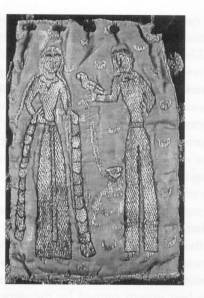
3 The Chelles P,ehquary: purse decorated with
scenes from courtly life. Mus6e de Chelles, 1170-80. The few surviving examples of medieval textiles give valuable information about embroidery techniques and about braids and bindings.
In quite a number of cases the traditional attribution has had to be revised after scientific analysis. Moreover it is not certain whether or not the garments have been preserved in their original form. Liturgical garments were some- time restyled to suit the fashion of the day, and civilian clothing was even more liable to be altered. There is certainly much more still to be discovered in the treasuries of cathedrals and churches or inside reliquaries and shrines. As far as armor is concerned, most of the suits of armor to be found in museums date from the late Middle Ages and their numbers have been reduced since recent more critical examination weeded out some fakes and some improper reconstructions. The authentic pieces mainly come from royal armouries and do not accurately represent the equipment of a medieval warrior. Coats of mail are more frequent, as are suits of ceremonial armor designed for jousting and tournaments. The oldest and commonest styles have not survived because the metal studs fixed to a leather tunic were easy to remove and return to the forge.
The finding of new information depends on the continuing development of medieval archaeology. Unfortunately, from the earliest days of Christianity, clothed burial was considered a pagan custom. Although it was eschewed for the majority, however, it was tolerated for the great, whether lay or clerical; their tombs are generally situated in churches or monasteries. In cases where conditions for the preservation of organic remains were favorable, excavation of these tombs reveals how the different items of dress were worn together. The single tomb of the Princes of Castille not to have been ransacked by Napoleon's troops, in the monastery of Las Huelgas near Burgos, is a case in point. Here a complete outfit was found, from the shoes to the headdress, in an admirable state of preservation; it had belonged to the Infante Fernando de la Cerda, a known historical figure whose death in 1211 is securely documented. Flimsier evidence often has to suffice: bits of rag or strips of cloth elicit more doubtful reconstructions. Towards the end of the Middle Ages the precepts of the Church were interpreted more loosely and a number of graveyards have yielded vestiges of clothing, in particular leather and metallic remains. Only one graveyard so far has yielded gowns and hoods of coarse wool, the Greenland village of Heolfsnes, which was occupied in the fourteenth century by a population of Scandinavian origin. Occasionally, after a battle, some of the victims would be tossed into a common grave without being undressed; this was the case at Visby, on the Swedish island of Gotland, where archaeologists have unearthed armaments that can be precisely dated to 1361.
Excavations of early inhabited sites, particularly in towns where the medieval archaeology is protected by thick layers of stratification, have contributed enormously to increasing our knowledge. Although their products are more difficult to interpret than material from burial grounds (because they are generally less well preserved) they have the advantage of being more numerous and more diverse. Because leather can withstand damp conditions, shoes have been recovered in great quantity. The patched boots of ordinary people and the cutwork shoes and painted patterns of the aristocracy share the same grave. Vegetable fibers, unlike wool and especially silk, rarely survive burial. In London the banks of the Thames and wells on other sites have yielded hoods and hose, caps and hats, and fragments of garments large enough to allow the reconstruction of a robe or gown, as wen as innumerable scraps of fabric and ribbon. No other source has given so much information about raw materials, techniques of spinning and weaving, dyes and methods of cutting and stitching. When soils have been too well ventilated to favor the preservation of organic materials, the metallic accessories still remain. Museum collections usually display only the most elaborate of these finds, with the result that the more ordinary items have until recently remained virtually unknown. Silver or bronze fibulas, buttons and buckles and other belt ornaments often reproduce the forms of more costly models. The evolution of forms permits the historian to trace the spread of fashion and to chart the passage of different types of ornament from one social class to another.
If we want to understand the relationship between the types of garment worn in the Middle Ages and the meaning accorded to each type by its contemporaries, it is not sufficient to analyze images, documents and objects separately. Evaluation of the authenticity of the various sources is, however, a necessary stage in the process. To reconstruct the costume of men, women, children and old people of the entire medieval, West, in all its diversity, is obviously an impossible task, but close examination of the available sources opens new areas of study.
The synthesis of the knowledge contributed by all the different sources is no easy task. However detailed a text may be, it remains difficult to relate the written word to the regalia supplied by archaeology or the images of iconography. Latin and the vernacular languages use different names to designate the same object and regional variants accompany fabrics, fur and fashions across national boundaries. Language has a tendency to develop at its own pace. One term often persists while the shape of the garment or its length changes; technical progress in the art of dyeing meant that shade or depth of color might alter.
There are, however, methods of establishing links between the medieval fabrics or garments that remain, and accurate terminology. Samples of fabric attached to a few extremely rare and valuable commercial documents give specific details about the type of fabric and its color. The scientific analysis of fabrics, in conjunction with often very detailed trade regulations, comes some way towards sorting out the minefields of fabric names and descriptions of colors. Archaeological samples allow the nature and quality of the fibers to be examined and methods of spinning, weaving and dyeing to be assessed; laboratory experiments have proved particularly useful in completing the information that we already have, particularly with regard to amounts used and methods of applying the dyes.
The identification of raw materials from representations is a relatively simple matter as far as furs and decorated silks are concerned, provided that the illustrations are in color and of large enough size. Even when they are large, however, it is difficult to distinguish silk from wool except by pattern: wool fabrics were suitable only for geometrical forms, stripes or checks, whereas silk-weaving looms made a variety of patterns available. Even cotton cloth, when dyed, is hard to distinguish from plain wool or silk. Finally, although sculpture can convey the appearance of miniver and other furs, or the pattern on a fabric, it is hazardous to try and identify a piece of material that the artist himself may not have attempted to represent in a particularly realistic fashion simply by its fall or by the way pleats or folds are depicted.
In the case of liturgical garments, it is easy to connect medieval terms with the garments that have survived because the names have not changed since the Middle Ages. Civilian clothing is a different matter, as is shown by the hesitation over what to call the famous 6pourpoint' preserved in Lyons (Mus6c histon'que des tissus). Close study of princely account books, with their details of materials, measurements, accessories and tailoring, allows one to match technical characteristics with a given designation. A number of attempts have been made to compare documents of an identical date and from the same regions, with encouraging results. Extreme caution is necessary,however, if erroneous identifications are to be avoided. One of the most famous examples is the word 'hennin', applied to the tall pointed hats worn by women at the beginning of the fifteenth century and used on the strength of a much later commentary, at several removes from the original. It appears that a preacher, who was a member of an order particularly opposed to women's interest in personal adornment, promised indulgences to children who would help him in his mission by shouting 'Au hennin!' at any woman wearing such headgear. His invective was taken to be the actual name of the hat.
In spite of gaps and problems of interpretation, surviving sources, especially after the thirteenth century, give a complete enough picture for us to have at least a glimpse of the diversity and contrasts of medieval costume.
Conclusion
THE EVER INCREASING IMPORTANCE given to primary source
material has played a crucial role in recent developments in research into medieval costume. Greatly improved study of iconography and the analysis of economic and technical documents as well as archaeological finds have enormously extended our understanding of what raw materials were available during the period and of how they were used. As a result of the development of cloth manufacture, with concomitant technical improvements throughout that process - hence also the development of silk production in the south and the expansion of the fur trade - purchasers were offered an increasingly great choice in the matter of materials, as well as a stream of new products. The methods whereby clothing was procured also witnessed great change. As urban workshops sprang up, estate and domestic production gradually decreased as specialists took over. The system of gifts and distributions, embedded in Christian ideology as well as in the social structure of feudal society, did not, however, disappear at this juncture.
As far as clothing was concerned, the speed and nature of change was based on wealth and social position and therefore varied widely. The vast majority of the populace, in the region of ninety per cent, belonged to the peasant class; peasants and the urban poor constituted a working class whose clothing was essentially utilitarian and changed only very slowly. Even when adaptations were made to accommodate climatic conditions or the requirements of different types of labor, these were made with limited resources and solutions that were generally of the simplest; a few items of genuine working clothing began to make their appearance. The driving force behind change was to be found at the other end of the social scale among monarchs and warriors, who held political power and disposed of very considerable wealth. The moral code of the chivalrous class considered largesse a cardinal virtue and encouraged its members to set them- selves apart from the rest of the populace by the brilliance of their appearance. The increasing popularity of the short, fairly fitted clothing worn by those who rode horses was, for a while, eclipsed by the long billowing tunics favored by southern Europeans. Finally, how- ever, the short costume in two pieces won the day for the laity, though it would sometimes be amplified by a long gown or a mantle to give dignity. The social significance of clothing, undocumented in the early Middle Ages, was made crystal clear by the sumptuary laws towards the end of the period. Economic motives were of less importance to the authors of the law than the concern to accord each individual a rightful place in society. Even a royal princess might be liable to some restrictions on the extravagance of her dress; women never shared their husband's rank, whatever social class they belonged to, and at least in aristocratic society, this subordination had an influence on the way they dressed. At other social levels women appear some- times to have dressed more elegantly: working-class women wore colored fabrics with greater frequency, perhaps on account of the types of activity in which they were engaged. Increase in travel and family visits between royal and princely courts (wars and dynastic quarrels permitting) help to explain the gradual spread of most male fashions all over the Western world. Regional differences, more obvious in female than male fashion, can be explained by lesser participation in travel and fewer international contacts.
The full significance of clothing went further than the mere definition of social class, gender or regional difference. While attitudes to nakedness and states of undress revealed a high degree of consensus, as did variations in clothing according to age, there were deep divisions in attitudes to personal status, whether inherited, acquired or chosen. Distinctive features of a more and more elaborate kind multiplied on clothing and accessories, proving the medieval sensitivity to visual signs and also the medieval taste for encoding people and situations. On the other hand working-class clothing bore few distinctive signs. The extravagance of the clothing worn by religious functionaries, little changed since the sixth century, had a strong influence on what was worn by kings and emperors at their coronations, all intended to exalt and enhance the dignity of the rulers. Conversely monks and friars, who had renounced the world, expressed their renunciation in simple clothing or sometimes, in some of the orders, in clothing pushed to exaggerated extremes of poverty. Similarly the insignia procuring positive recognition for knights, crusaders, pilgrims and Oater) the orders of chivalry contrasted with the negative marks imposed on 'deviants' from the prevalent religious and moral codes. From the thirteenth century Jews, Muslims and heretics were made to wear distinguishing markers on their clothing. The fate of the prostitute, left to the discretion of local urban authorities, was more variable. Sufferers from the only illness recognized as contagious, leprosy, were restricted to a few areas and, very late in the day, forced into distinctive garments; more usually it was an accessory, noisy and very visible, that heralded their arrival and frightened others away. There were times and places however when Western society in the Middle Ages escaped from societal constraints and conventions. Carnivals and charivaris had a certain anarchic quality, sometimes expressed quite violently and in extraordinary garb. In courtly surroundings, however, although still inspired by the idea of the world upside down, and redolent with animal disguises which had emerged from the remains of paganism, fancy dress was enjoyed at a more refined level even though the theme of the wild man continued to be particularly popular. On a daily basis, the brilliantly colored, exotic clothing of Moorish slaves, of fools (both men and women) and minstrels created a milieu for the courts in which imagination and fantasy had free rein. On a similar note, behind the expressions of loyalty and allegiance, parades and processions staged by towns in honor of a royal visit embodied the rising power of the urban aristocracy.